

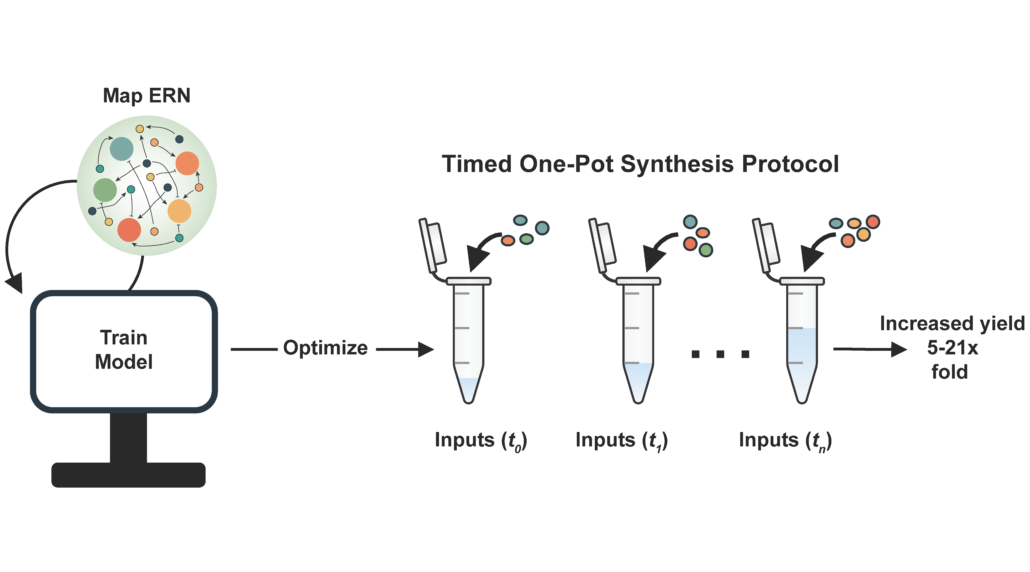
Publication: Timed batch inputs unlock substantially higher yields for enzymatic cascades
Cell-free enzymatic reaction networks (ERNs) enable the production of value-added compounds in a single cascade. However, various interactions, such as allosteric interactions, product inhibition, reversibility or competition for shared substrates become apparent only when all components of the ERN are assembled and lead to a reduced product yield.
In our newly published Nature Chemistry paper, we demonstrate a model-guided optimal design method to generate time-dependent ‘recipes’ for batch reactions. In this recipe, ERN components – enzymes, substrates and cofactors, are added at specified times and volumes repeatedly. We applied this approach to two ERNs in vitro, the pentose phosphate pathway (PPP) and a branched nucleotide salvage pathway (NSP), and achieved improved yields of more than 5- to 21-fold, respectively, in comparison to control reactions, where all reaction components were added at t=0.

